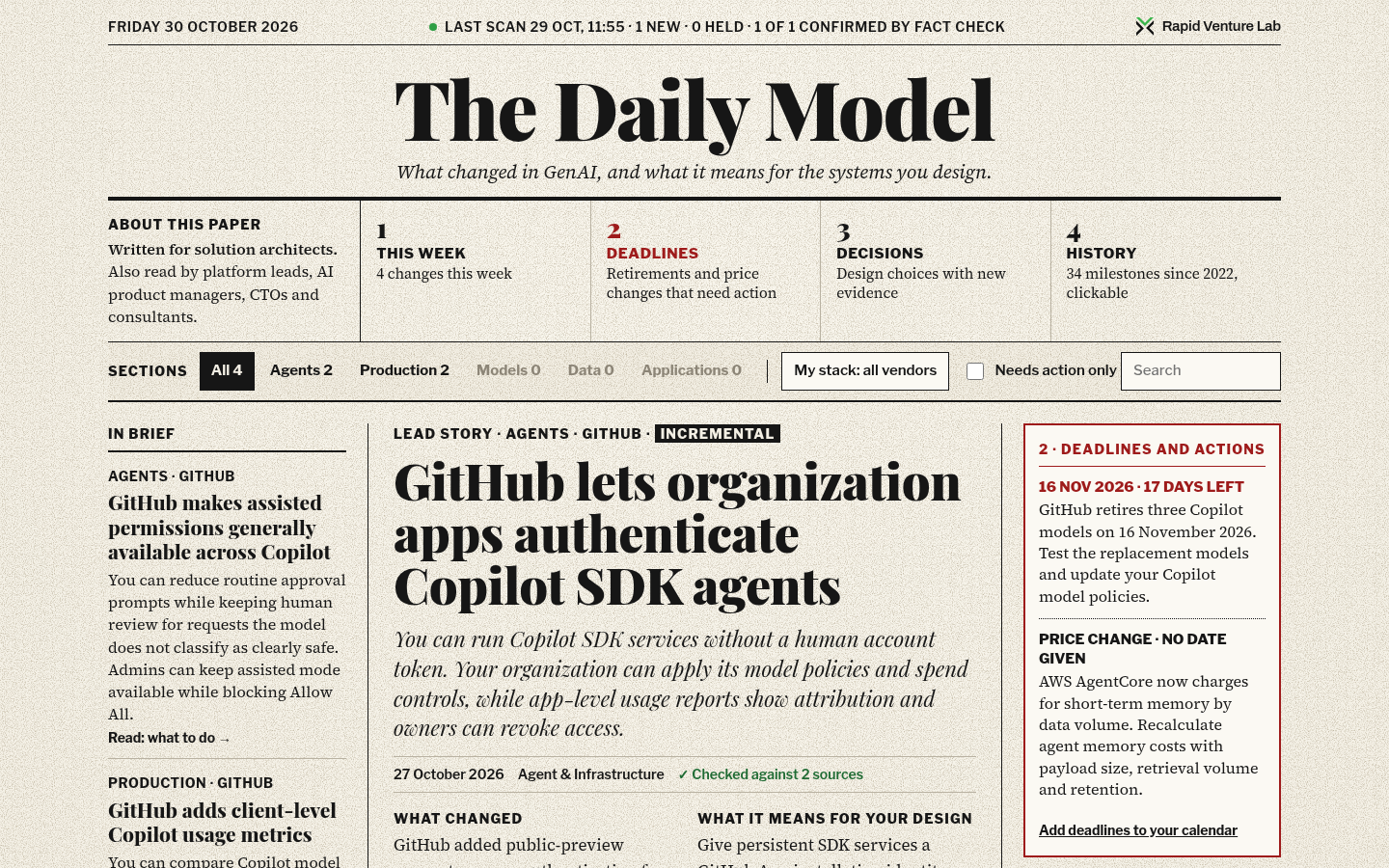
The Daily Model
What changed in GenAI, and what to do about it, every morning
A daily paper for solution architects. Agents find the changes, a second agent checks every claim against its sources, and the site rebuilds itself.
01 · The business problem
Model providers and cloud platforms change something almost every day: new models, retirements, price changes, new agent features. Solution architects need to know which of these changes affect the systems they design, and by when they have to act. The information is public, but it is spread across dozens of changelogs, docs and blogs. Most summaries also leave out what an architect needs most: what to do about it.
02 · The workflow
- Every morning, GitHub Actions starts a research agent. It reads vendor changelogs, documentation and engineering blogs, and writes new items to an inbox.
- An editor agent rewrites each item to the paper's style guide. A script throws the edit away if it changed anything besides wording.
- A script opens every source link. A second agent then reads each item's sources and compares every name, number, date and status with them.
- Items that fail a check stay in a held folder. Items that pass go into the dataset, and the site, the feed and the calendar rebuild.
- Once a month, another workflow reopens every milestone source and reviews new milestone candidates. Nothing enters the history until I approve the pull request.
Public sources
Vendor changelogs, documentation and engineering blogs
Every morning, on GitHub Actions
Research agent
Finds what changed
Editor agent
Rewrites each item to the style guide
Link check
Opens every source link
Fact-check agent
Compares each claim with its sources
Passes every check
Dataset
Every story and milestone, in one file
Site and feeds
Website, RSS, deadline calendar and open data
Fails a check
Held
Waits for my review
Once a month
Monthly review
Rechecks milestone sources and proposes new milestones
My approval
A new milestone enters the history only when I merge its pull request
03 · What I built
- The website: this week's changes by stack layer, a deadlines column, design decisions with new evidence, and a clickable history of milestones since 2022.
- The agent pipeline: research, editing, link check and fact check, run by GitHub Actions on a schedule.
- Style, schema and data checks, with a held folder for anything that fails.
- A style guide that the agents write to, and a script that enforces it.
- Feeds: RSS, a deadline calendar for Outlook, Google and Apple Calendar, and the full dataset as open data.
- A share page and a LinkedIn preview card for every story, rebuilt each day.
04 · Tools used
Claude Code · HTML, CSS and JavaScript · GitHub Actions · GitHub Copilot CLI agents · GitHub Pages
05 · Commercial use case
A team that depends on several AI vendors can use the same setup to track the changes that affect its own stack. Agents gather the changes, a second agent checks them, and a person approves anything that becomes permanent. The same pattern fits other fields that move fast, such as regulation or security advisories.
06 · Evaluation
The paper so far
The paper has published every day since 18 September 2026.
Counted from the paper's open data each time this page loads.
Current limits
Daily stories publish without a person reading them first. Only milestones need my approval. If the fact-check agent fails to run, items still publish, and the run's audit file records it. The fact check confirms what the sources say, so it cannot catch a source that is wrong itself.