BESS Financing Comparison
Battery project finance, three structures compared per MW
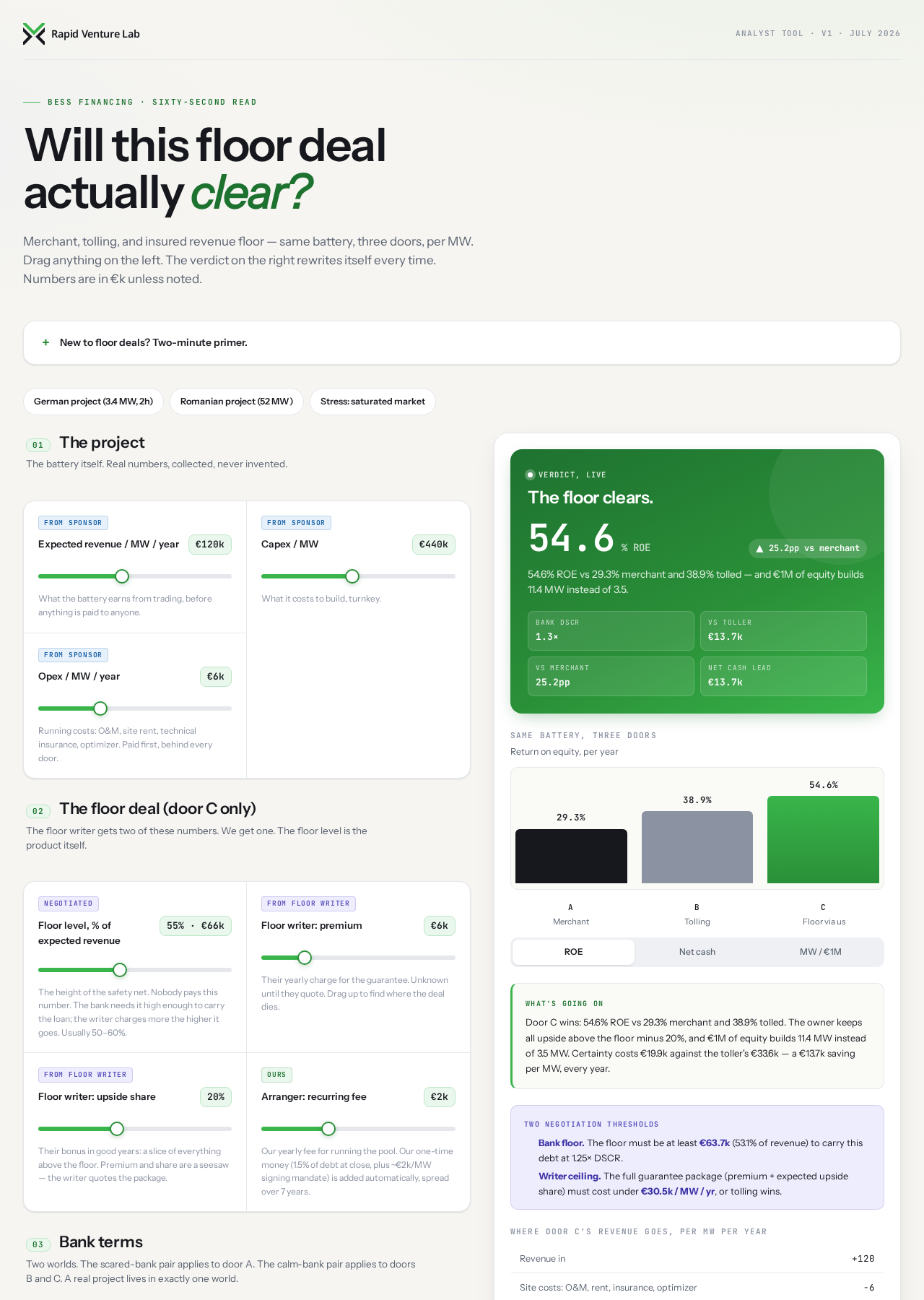
An interactive tool that compares merchant, tolling, and insured floor financing for a battery storage project, and shows the exact point where each deal stops working.
01 — The business problem
A battery earns money, but nobody knows how much it will make each year. That uncertainty makes banks lend little and charge a lot. Project sponsors face three financing structures and no clear way to see which one leaves them better off.
02 — The workflow
- The tool takes the sponsor's real project numbers and models all three financing structures side by side.
- It recalculates the verdict live as any input changes, so a negotiation can play out on screen.
- It surfaces the two thresholds that usually stay hidden: the minimum floor the bank needs, and the maximum price the floor writer can charge before tolling wins.
03 — What I built
- A live interactive tool with draggable inputs for project economics, floor terms and bank terms.
- A verdict panel that rewrites itself on every change.
- Clear labelling of who provides each number: sponsor, floor writer, arranger, or market.
- Built for an analyst to use in front of a counterparty.
04 — Tools used
React + Vite · shadcn/ui · Recharts
05 — Commercial use case
A structuring aid for battery storage project finance. Used to pressure-test a financing structure and walk into a negotiation knowing the counterparty's ceiling in advance.
06 — ROI and adoption
A structuring aid, not financial advice. All numbers are scenario inputs from anonymised project work.
Illustrative assumptions
- Every number in the tool is a scenario input drawn from anonymised project work. None of it is an offer or a term sheet.
- The point of the tool is to see where each structure breaks, so a sponsor can walk into a negotiation already knowing the counterparty's ceiling.
- Used as a structuring aid alongside a proper financial model and legal review, not as a replacement for either.